- Wealth Protection Research
- Posts
- Made in America. Sold to China.
Made in America. Sold to China.
The government blocked an American buyer. So now a Chinese company gets it instead.

Wealth Protection Research
December 15, 2025
In partnership with

Dear Reader,
In 1990, three engineers at MIT had an idea.
They would build robots. Not the clunky, industrial kind that welded car frames in Detroit factories, but something smaller, something that could navigate the chaos of an ordinary American home. They founded a company called iRobot and, after years of building machines for the military and NASA, they introduced a humble little disc that would vacuum your floors while you slept.
They called it the Roomba.
For two decades, iRobot dominated. At its peak in 2021, the company was worth $3.6 billion. The Roomba held 42% of the American market, 65% of Japan's. It was an American success story, born in the laboratories of Cambridge and shipped to living rooms around the world.
Today, iRobot filed for bankruptcy. Its shareholders will be wiped out entirely. And the company that invented the robot vacuum, that pioneered an industry, that represented three decades of American innovation, will be handed over to its Chinese supplier.
The irony, dear reader, is almost too perfect.
You see, Amazon tried to buy iRobot in 2022. They offered $1.4 billion. The deal would have kept the company American, kept the jobs in Massachusetts, kept the technology under domestic control. But the regulators said no. The Federal Trade Commission worried about competition. European authorities fretted about market power. After two years of investigation, the deal collapsed.
iRobot was left with a $200 million loan it had taken to survive the review process, a product line being undercut by Chinese competitors selling similar vacuums at half the price, and a new set of tariffs that added $23 million to its costs this year alone.
So now Shenzhen Picea Robotics, a Chinese company, will own the whole thing.
Colin Angle, the MIT engineer who co-founded iRobot and led it for three decades, put it plainly: "This should never have happened."
We mention all of this because it rhymes with a larger theme we keep returning to in this newsletter.
Wall Street's Daily Drama
Market Snapshot
Asset | Close | Change |
|---|---|---|
Nasdaq 100 | 23,057 | -0.59% |
S&P 500 | 6,817 | -0.16% |
Dow | 48,417 | -0.09% |
Bitcoin | $88,231 | -3.0% |
10-Year Treasury Yield | 4.04% | -0.06% |
Gold | $4,323 | +0.73% |
Silver | $63.94 | +3.35% |
Source: Yahoo Finance, Polygon, and CNBC.
Top Headlines In 60 Seconds
iRobot Files for Bankruptcy: The Roomba maker will be taken over by Chinese manufacturer Shenzhen Picea Robotics after Amazon's $1.4 billion acquisition was blocked by regulators. Stock falls 70%; shareholders will receive nothing.
Manufacturing Contracts Sharply: The Empire State Manufacturing Index plunges to -3.9 from +18.7, far worse than the +10 economists expected. New orders flatline while shipments turn negative for the first time in months.
Silver Surges on Weak Data: The white metal jumps 3.35% to nearly $64 per ounce as weak manufacturing numbers boost hopes for further Fed rate cuts. Silver is now up 109% year-to-date.
AI Trade Wobbles Again: ServiceNow falls sharply on reports of a $7 billion acquisition of cybersecurity firm Armis. Broadcom and Oracle remain under pressure as analysts question AI valuations.
The Year-End Moves No One’s Watching

Markets don’t wait — and year-end waits even less.
In the final stretch, money rotates, funds window-dress, tax-loss selling meets bottom-fishing, and “Santa Rally” chatter turns into real tape. Most people notice after the move.
Elite Trade Club is your morning shortcut: a curated selection of the setups that still matter this year — the headlines that move stocks, catalysts on deck, and where smart money is positioning before New Year’s. One read. Five minutes. Actionable clarity.
If you want to start 2026 from a stronger spot, finish 2025 prepared. Join 200K+ traders who open our premarket briefing, place their plan, and let the open come to them.
By joining, you’ll receive Elite Trade Club emails and select partner insights. See Privacy Policy.
The News Behind The News
The Critical Mineral Nobody Noticed
While the headlines focus on iRobot's demise and the latest wobbles in the AI trade, something quieter is happening in the precious metals market.
Silver jumps 3.35% today, pushing toward $64 an ounce. Gold rises more modestly, gaining about 0.7% to hover near $4,320.

The catalyst is this morning's Empire State Manufacturing Survey, which shows factory activity contracting sharply in New York State. The headline index plunges 23 points to negative territory, well below what anyone expected.
Bad news for the economy, in other words. But good news for the metals.
The logic is straightforward enough: weaker economic data strengthens the case for the Federal Reserve to keep cutting interest rates. Lower rates reduce the opportunity cost of holding assets like gold and silver, which pay no yield. And so money flows into the metals whenever the economic picture darkens.
But there's something else going on with silver that deserves attention.
Last month, the U.S. Department of the Interior added silver to its official List of Critical Minerals for the first time. The designation recognizes what the market has been signaling for years: silver isn't just a precious metal anymore. It's an industrial necessity.
Solar panels require silver. Electric vehicles require silver. The data centers powering all that artificial intelligence everyone keeps talking about require silver. Medical devices, 5G infrastructure, defense systems, they all require silver.
The market has been in deficit for four consecutive years. Demand keeps rising while mine supply stagnates. The U.S. imports 64% of the silver it consumes.
And now the government has officially acknowledged what silver stackers have known all along: this metal is strategic.
The Pattern Repeats
We keep coming back to the same observation, not because we lack imagination, but because the pattern keeps asserting itself.
Paper assets require stories. They require narratives, projections, confidence in management, faith in future earnings. When the story changes, the asset reprices violently. iRobot shareholders are learning this today. So did anyone holding ServiceNow or Broadcom last week.
The AI trade, which seemed unstoppable six months ago, now looks "toppy," according to BTIG's technical analysts. The market's leaders are posting lower highs and lower lows, the classic signature of a momentum shift.
Meanwhile, Bitcoin slides back toward $86,000, down about 3% on the day and roughly 7% for the year.
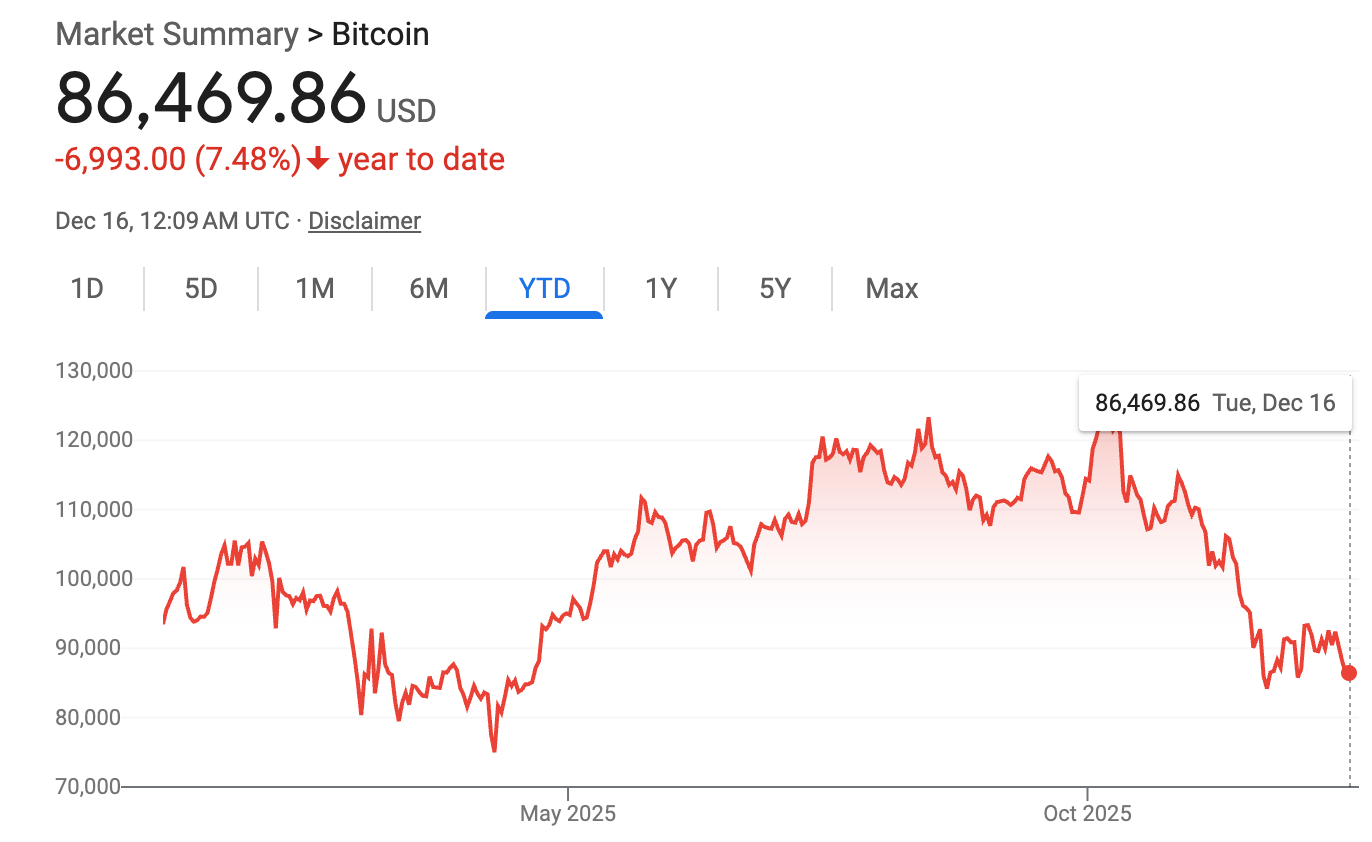
The Crypto Fear & Greed Index sits at 16, which its creators label "Extreme Fear." Just a year ago, Bitcoin was supposed to hit $200,000 by now. It hasn't.
We don't mention this to gloat. Plenty of intelligent people own Bitcoin and believe in its long-term value. They may be right. We simply note that assets built on narratives can disappoint when the narrative shifts.
Gold and silver don't need narratives. They don't hold earnings calls or issue forward guidance. They don't file for bankruptcy or get blocked by regulators or sold to foreign competitors.
They just sit there, as they have for five thousand years, waiting patiently for the paper promises to reveal themselves.
What the Factories Are Telling Us
The Empire State data deserves a closer look because it confirms what we've suspected: the economy isn't as robust as the stock market suggests.
New orders flatline in December. Shipments fall sharply. The headline index goes from its highest level in a year to contraction in a single month.
The silver lining, if you'll pardon the phrase, is that manufacturers grow more optimistic about the future. The forward-looking index jumps to its highest level since January. They expect conditions to improve.
Perhaps they will. Perhaps the Fed's rate cuts and the administration's promised deregulation will spark a manufacturing renaissance. We've heard that story before.
What we know for certain is this: when factory activity weakens, the metals tend to strengthen. The correlation isn't perfect, but it's durable. Bad economic news pushes the Fed toward easier policy, easier policy weakens the dollar, and a weaker dollar lifts gold and silver priced in that currency.
The machines can vacuum your floors, but they can't print money. Only the Fed can do that.
The Bottom Line
We started with three engineers at MIT who built something remarkable, a company that put robots in American homes and dominated a global market for two decades.
We end with that company's innovation being shipped to China because the government that was supposed to protect American industry blocked the one deal that could have saved it, then imposed tariffs that accelerated its decline.
The founding engineer calls it a tragedy. We'd call it a parable.
Paper assets, whether they're shares in a robot vacuum company or tokens on a blockchain, depend on stories that can change overnight. A regulatory decision, a competitive threat, a shift in tariff policy, and decades of value can evaporate.
Silver doesn't care about regulators or tariffs or competitive threats from Shenzhen. It was valuable when the Romans mined it in Spain, when the Spanish conquistadors shipped it from Peru, and when the Hunt brothers tried to corner the market in 1980.
It's valuable today, up 109% in a year, newly designated as a critical mineral, and rising on every hint of economic weakness.
The Roomba will keep cleaning your floors, at least for now. The Chinese will own the patents. The shareholders will own nothing.
But the metal endures.
The Wealth Protection Research Team